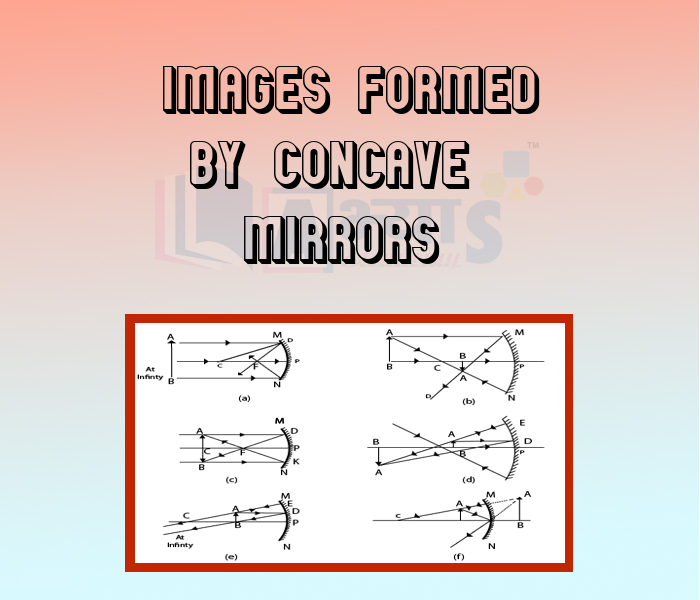
Images Formed By Concave Mirrors









Defects Of Vision And Their Correction
Defects of Vision And Their Correction:
Myopia or Short-sightedness: In such a defect, one can see the nearby objects cleariy but it is difficult to see the objects at long distances. In such a defective of cye the image of distant objects is formed front of the retina at not at retina. This can be corrected by using a concave (divergent) lens.
Hypermetropia or long-sightedness: In such a defect, the distant objects are seen clearly, whereas the nearby objects look blurred. In this case, the image is formed behind the retina. This defect is known as long-sightedness or hypermetropia. It can be corrected by using a convex lens (converzing lens) of appropriate focal length.
Astigmatism: This defect is due to the cornea not being spherical. As a result, the rays of light entering the eye in different planes are brought to a focus at varying distances from the retina. So, through the object is a point, the shape of the image may be a line, a circle or any other shape except a point. This defect can be corrected by using a cylindrical lens, instead of a spherical lens.
Presbyopia: It is usually due to advancing age of the humans. In this condition, the lens becomes less flexible and near point recedes from the eye. As a result, the objects far away cannot be seen. This defect can be corrected by using a converging lens.
Students / Parents Reviews [10]
I have spent a wonderful time in Abhyas academy. It has made my reasoning more apt, English more stronger and Maths an interesting subject for me. It has given me a habbit of self studying

Yatharthi Sharma
10thOne of the best institutes to develope a child interest in studies.Provides SST and English knowledge also unlike other institutes. Teachers are co operative and friendly online tests andPPT develope practical knowledge also.

Aman Kumar Shrivastava
10thMy experience with Abhyas is very good. I have learnt many things here like vedic maths and reasoning also. Teachers here first take our doubts and then there are assignments to verify our weak points.

Shivam Rana
7thAbhyas is a complete education Institute. Here extreme care is taken by teacher with the help of regular exam. Extra classes also conducted by the institute, if the student is weak.

Om Umang
10thAbout Abhyas metholodology the teachers are very nice and hardworking toward students.The Centre Head Mrs Anu Sethi is also a brilliant teacher.Abhyas has taught me how to overcome problems and has always taken my doubts and suppoeted me.

Shreya Shrivastava
8thBeing a parent, I saw my daughter improvement in her studies by seeing a good result in all day to day compititive exam TMO, NSO, IEO etc and as well as studies. I have got a fruitful result from my daughter.

Prisha Gupta
8thMy experience with Abhyas academy is very good. I did not think that my every subject coming here will be so strong. The main thing is that the online tests had made me learn here more things.

Hiya Gupta
8thAbhyas Methodology is very good. It is based on according to student and each child manages accordingly to its properly. Methodology has improved the abilities of students to shine them in future.

Manish Kumar
10thIt was a good experience with Abhyas Academy. I even faced problems in starting but slowly and steadily overcomed. Especially reasoning classes helped me a lot.

Cheshta
10thIt was good as the experience because as we had come here we had been improved in a such envirnment created here.Extra is taught which is beneficial for future.